
I’m sure it will be a very different project, but still one with plenty of challenges. After all, with everything needing to be as flawless as possible, I won’t be able to hide anything with additional layers of dirt when mistakes happen…
27th November 2025

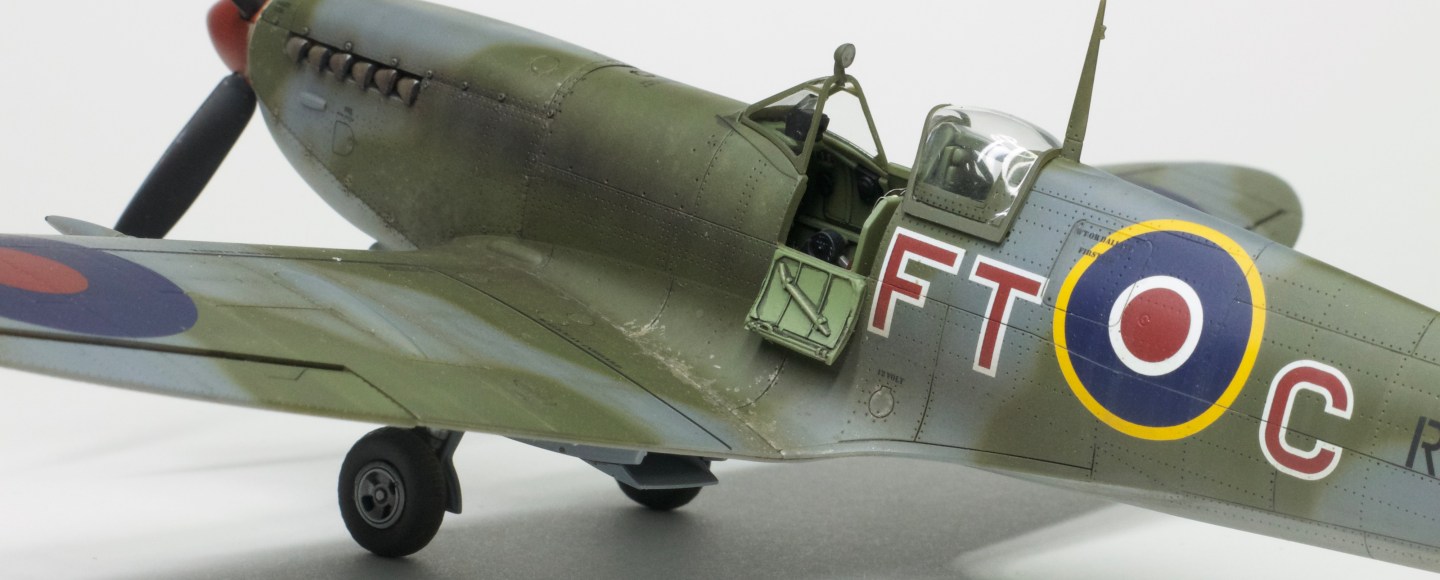
Last week I posted a couple of photographs of my – at the time – almost complete Airfix Spitfire MK.IX onto my Book Of Faces. In one of those images I had simply painted the model, applied the decals and sealed it all in with a layer of VMS Satin varnish. It was all fairly standard stuff, with an additional pat on the back that I was happy to give myself.
As is usual with these little updates, modellers were keen to offer their thoughts on the model as it stood and then ask me questions about my process, and the materials used. Again, all fairly standard stuff. What wasn’t perhaps quite so standard were the number of modellers who really liked the way the model looked, sans weathering. My model it would seem had captured their imagination not because of its eventual weathered finish, but because it was unfettered, unadorned with the painterly trappings of the hobby in 2025.

Though I don’t really like heavily-weathered models, all of my builds exhibit some form of distress, even if that’s little more than some washes here and there. Even those that are ostensibly clean have a degree of additional patina that try to replicate a little use. Nothing is therefore, pristine.
Back in the day, as the cool kids would say, aircraft models would appear in print and at shows painted with often zero layers of weathering. Whereas military subjects, vehicles, dioramas et al, had the kinds of dirt and degradation we see today (if not a little more naively applied…), aircraft would be painted as-is, all smooth finishes and neatly applied decals. That’s just the way it was back then. And then slowly but surely, things started to change…
I don’t think that anyone who’s enthusiastically part of this hobby will argue with a straight face that weathering is not now a fundamental part of almost every build that you see, no matter where. Entire industries have developed around materials used to create miniatures that display more of their environments on their surface, than their underlying camouflage and markings. Modellers now announce with glee that the construction and basic painting is secondary to their desire to get to the fun part: the weathering. I’ve had comments that my models would look better had I weathered them more, even if I’d tried to replicate a machine that was in reality, clean. Why? Because models are seemingly no longer interesting to a lot of modellers if their surfaces are not bedecked in layers of filth. Such is this shift in approach that I’m now more convinced than ever that the hobby is now not so much about making, as it is about painting.
Going back to that little image of my Spitfire, I have over the last few days or so, pondered a simple question: do models have to be weathered to be interesting? Can a miniature painted as they were in my formative years, still be seen as worthy of attention in 2025. Well, I’m about to put that to the test…
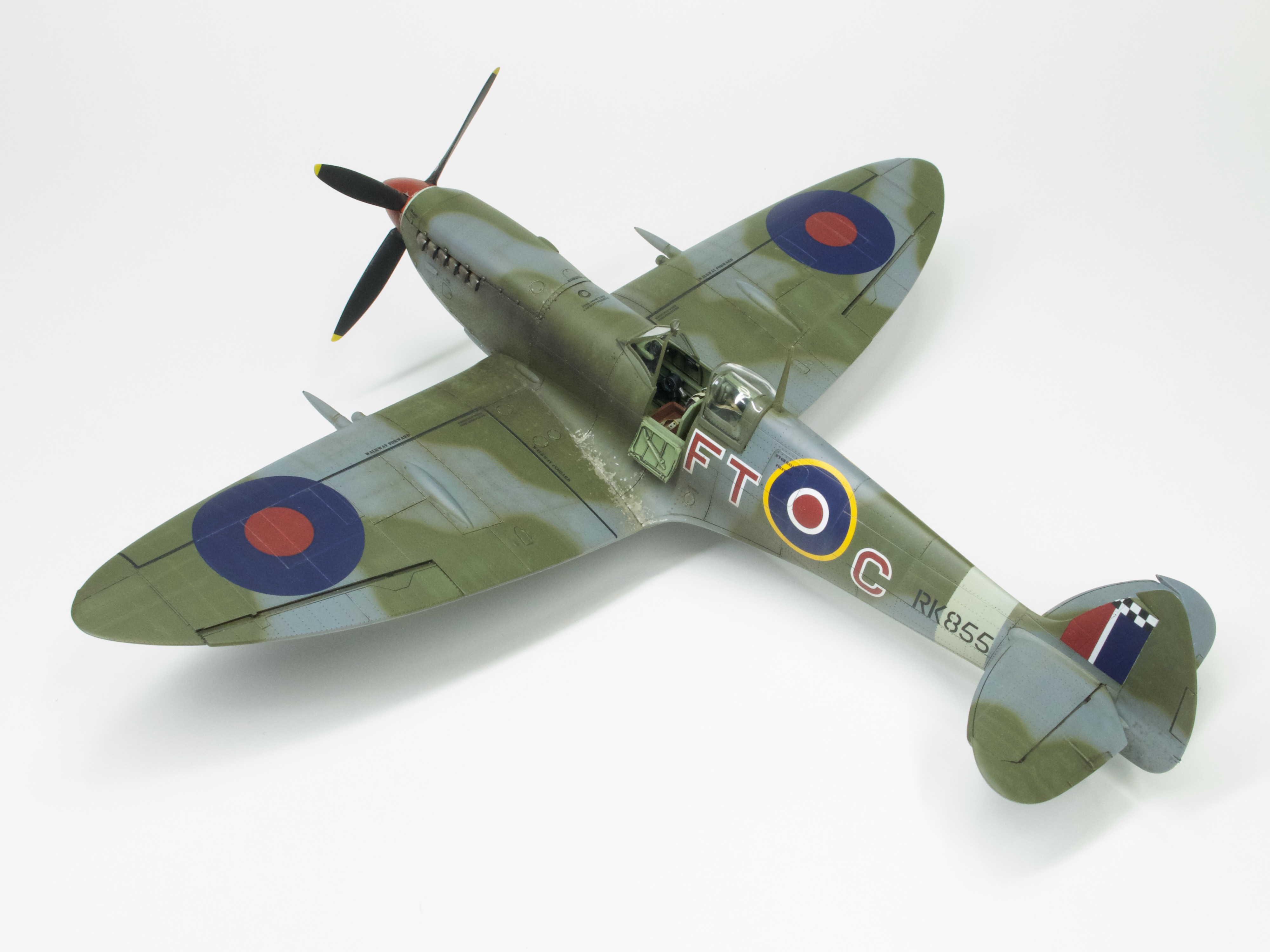
Having completed my Spitfire in a weathered finish, my next model for Brett will be painted without any of those additional effects. I plan to paint everything in flat colours, keep all details and camouflage as sharp as possible and then apply the decals as seen on the airframe of the Spitfire. Panel lines will not even be defined. I’m going to let the kit, its detail and a neat finish, do all of the talking. Then, once completed, I can compare the results with models already built to see if this can be a pathway I can use occasionally going forward. It will be a retro build that I can use as a gateway to the future.
Brett and I haven’t settled on a possible kit yet, but we have some ideas. When we do I will let you know and will then post the occasional update over the next two weeks on the way to completion during mid December. I’m sure it will be a very different project, but still one with plenty of challenges. After all, with everything needing to be as flawless as possible, I won’t be able to hide anything with additional layers of dirt when mistakes happen, as they so often do during my many projects each year. That pressure in itself will be worthy of the challenge.
See you tomorrow.
 SPENCER POLLARD'S KIT BOX
I’m glad that you have analysed the whole “whether to weather or never to weather” idea that seems to be a big part of the whole modelmaking process nowadays and yours is a point well made!!
I am a senior modeller of many years in the hobby and to my mind, building a model of any genre in a clean, sharp and shiny way is infinitely harder than using weathering as a way of covering up your mistakes. Clean and shiny leaves nowhere to hide, so it has to be perfect and ultimately shows a higher degree of skill to my mind!
When I see a heavily weathered model covered in mud and grime and displayed alone on a shelf without a diorama, it just looks like a badly built model to me. In a diorama, fine, it is part of a story, or dialogue and would look odd all shiny and new, but looks totally odd alone on a display shelf.
I love seeing a nicely detailed, clean and clearly well built model on display at a show. It’s how it used to be way back when we bought our models how they came, in clear plastic bags with header cards and Woolworths was the only LMS in town and there was zero weathering products or techniques!!
Looking forward to seeing your retro build Spencer!!
Kev
LikeLike
I don’t get the idea that not weathering and a clean finish is “harder” to me that doesn’t make any sense, it’s different, that’s all. I don’t think the hobby has lost anything with this shift towards finishes over building at all. I think its an overall shift towards making the hobby more creative and overall interesting, I think the push that kept aircraft modelling so clean for so long has actually done the aircraft side of the hobby harm and it’s why so many younger guys (relative term) are into armor over aircraft now.
LikeLike
Successful models evoke the emotions and impressions of their subjects, and their finishes should re-create for the viewer the colors and texture of the subject. Weathering, in its infinite variations and approaches, is one way to achieve such re-creation, but not the only way. I look forward to your exploration of all the ways models can be successful, with or without ‘in vogue’ weathering techniques.
LikeLiked by 2 people
I assume we ‘weather’ to make a subject look realistic. I can see three reasons not to do this.
1. It takes take, sometimes a lot of time. This reduces throughput and sometimes leads to burnout with a model and it’s abandonment.
2. Somethings in real life aren’t weathered. Parade standard certainly exists in the military, even in wartime, albeit much reduced. Some civilian subjects are often frequently cleaned and kept in tip top condition. For example, I’ve yet to see a police helicopter or air ambulance that looks anything but pristine at normal viewing distance. Ditto top-tier motor sport subjects, at least at the start of a race. The idea of concourse condition is well established in the motor trade and can apply to trucks and earthmoving equipment
3. A model is by its nature an illusion and really a form of art. I think you, Spencer, have used the term modelling art-form in the past, so why not try a different art-form, to see if it helps us see the subject in a new way. Perhaps to better see shape and form, or to create a purer notion of the essence of the subject.
It’s a great article and has challenged me.
LikeLike
On target! fire for effect. It’s a hobby and supposed to be fun… I have plenty of nice clean aircraft on the flightline pix; Surefire 85 at Sembach, where F-16 and F-4E/G had minimal soot and grime because the Crew chiefs and the load team busted their tail to show off a pristine aircraft. Was there, saw it personally, and captured pix.
LikeLike
Sent from my iPhone
LikeLike
Pingback: A MODELMAKER’S LIFE: 2025’S WORK ALL WRAPPED UP… – SPENCER POLLARD'S KIT BOX