
I cannot remember the last time I was inspired to build a kit after seeing one built by someone else – in fact, the opposite might be true: the more I see a new kit being built, the less I will want to have a go!

New kits are great fun to build, but when your interests are rather less mainstream in nature, suddenly, they become less important in the face of vintage offerings that allow you to realise your modelling dreams, where those new kits cannot…
If there is one thing that I’ve realised over the last few years, it’s that modern kits are no longer that interesting to me. Though I love to see them being built and indeed, enjoy them passing over my workbench on a regular basis, their release and arrival is not likely to get the juices flowing as much as a kit that I can grab and wrestle with, to create something truly unique. All things being equal as the old saying goes, should I choose to build a model for myself (still, thankfully, something I get to do more often than not) that will never be a new kit, older, more flexible offerings taking precedent every single time.
“Yeah, but you must be inspired to build a new kit when you see them online or in magazines.”
Not really, no.
I cannot remember the last time I was inspired to build a kit after seeing one built by someone else – in fact, the opposite might be true: the more I see a new kit being built, the less I will want to have a go! It’s a failing I know, that says more about my drive to build models, than it does to build, kits. These days, if I want to build something that can only be built using an old kit, I will. I won’t consider shelving that idea simply because I feel it is in my best interest to grab something shiny and knew to follow other modellers. I no longer need to fit in. I no longer want to fit in. When being part of the in-crowd scene was a drive that I couldn’t get past for fear of being forgotten, today it’s no longer a consideration. At the risk of being forgotten, I build the forgotten and that makes me happy, at least it does when New models are great fun to build, but often, vintage kits allow you to realise your modelling dreams, where those new kits, cannot…projects run on rails and don’t drift off into the ditch!

Several weeks ago, I once again sat down to decide what to build for Brett Green as part of my day job. I work for both Brett and Marcus Nicholls, each having different needs for their respective publications. Brett gives me plenty of leeway to chose my own builds, Marcus tends to be more specific, his projects often dealing with new kits that he wants to reveal to his readership. It’s a perfect arrangement because it allows me to keep feet in both camps old and new, and that, allows me to discuss each aspect of the hobby based on experience, rather than simply talking for the sake of I about subjects and genres that have no experience of.
If you like what I do on this page, please subscribe!
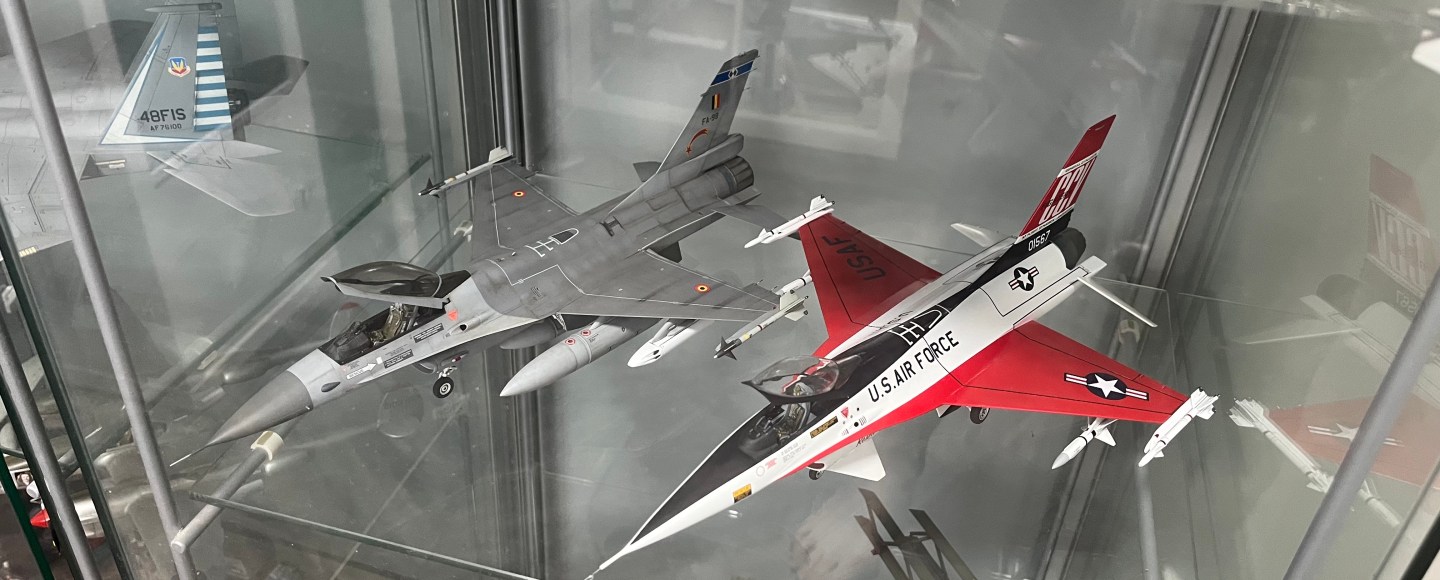
Having considered for a while if this time around I would once again build something for Brett that was newly released (as in Kinetic’s superb F-16A that I completed for him a month or so ago) I once again decided that the kit would not be the driver, but instead, I would have a go at another off-the-wall subject. This time around I would tackle the F-16 ‘Control Configured Vehicle’ or rather more pithily for the purposes of this essay, CCV.

The only way to model this aircraft is to reach for an ancient YF-16 kit and convert it. Here, we have a situation where the driving force behind the build was the prototype and not a kit that’s available for it. My enthusiasm was heightened by the chance to build a model that looked like 5% of F-16s, rather than 95% and thus the excitement that I felt as it was coming together, built with each passing day. I’d wanted a model of this aircraft for some time and was delighted to see that finally happen. Along with the subject, it also allowed me the chance to indulge in another conversion, one that I had to build from scratch rather than using an off-the-shelf conversion kit. It would once again push my skills, my references and my determination to get the job done. Ending up with something unique at the end of the process was simply the icing on the cake.
“But why do you need to do this? What’s your motivation?”
It’s simply this: I have to be different.
After decades building models, 30 as a professional (almost) I no longer feel the urge to build what other modellers, including friends, are building. Now, with time passing by, I want to build real subjects that I love whilst I can, not just kits for the sake of it of disparate subjects that I have little or no interest in. With many of my loves being oddball prototypes, that almost always means that I am now converting older kits simply because there is no other option available. subject first, kit second.
“Okay, but what if a manufacturer was to release CCV in miniature – for instance – and you had a chance to build it from a new kit?”
Honestly, I don’t think I’d want to do build it that way.
Though that sounds massively counterintuitive, it would go against my desire to be different. If I was to do that, I would simply have a model that was the same as those built elsewhere and the unique nature of my project would no longer be enough to begin work. In this case my decision to build CCV (apart from my love of the aircraft) came about as result of wanting to be not only different, but also to create something that readers of MAI could enjoy and perhaps inspire them to travel a path less well trodden. How many 1/48 CCVs have you seen? I’m not sure I’ve seen one in the flesh, so that’s enough to set my build apart. There’s the difference.
There’s also the competitive nature of this hobby. By building a kit that everyone else has completed, your work is, perhaps not overtly but certainly subconsciously, judged against that of others. I do it myself and I hate it when it happens.
“How does mine compare?”.
I wonder if X, Y or Z has added these details, chosen this scheme, painted it this way?”.
“Is the finish on mine, better or worse than Joe Bloggs’..?”.
Aaaaaaaggggghhhhh!
So I decided some time ago not to do that, not to place my builds against those completed by other modellers. That makes sense, right? I’m no longer a competitive modeller (I’ve entered one competition in the last five years and only did so because I needed a place to display a new build) so the idea of having my worked judged is anathema, both when I do it and when it’s done by others. I only want my models to be assessed against what I have built before, not a third party and to do that, I have to plough my own furrow. After all, it’s hard to compare a model to someone else’s, if you are the only one that’s built it! It’s a difficult psyche that I live with, but one that hopefully, others understand! Anyhoo…
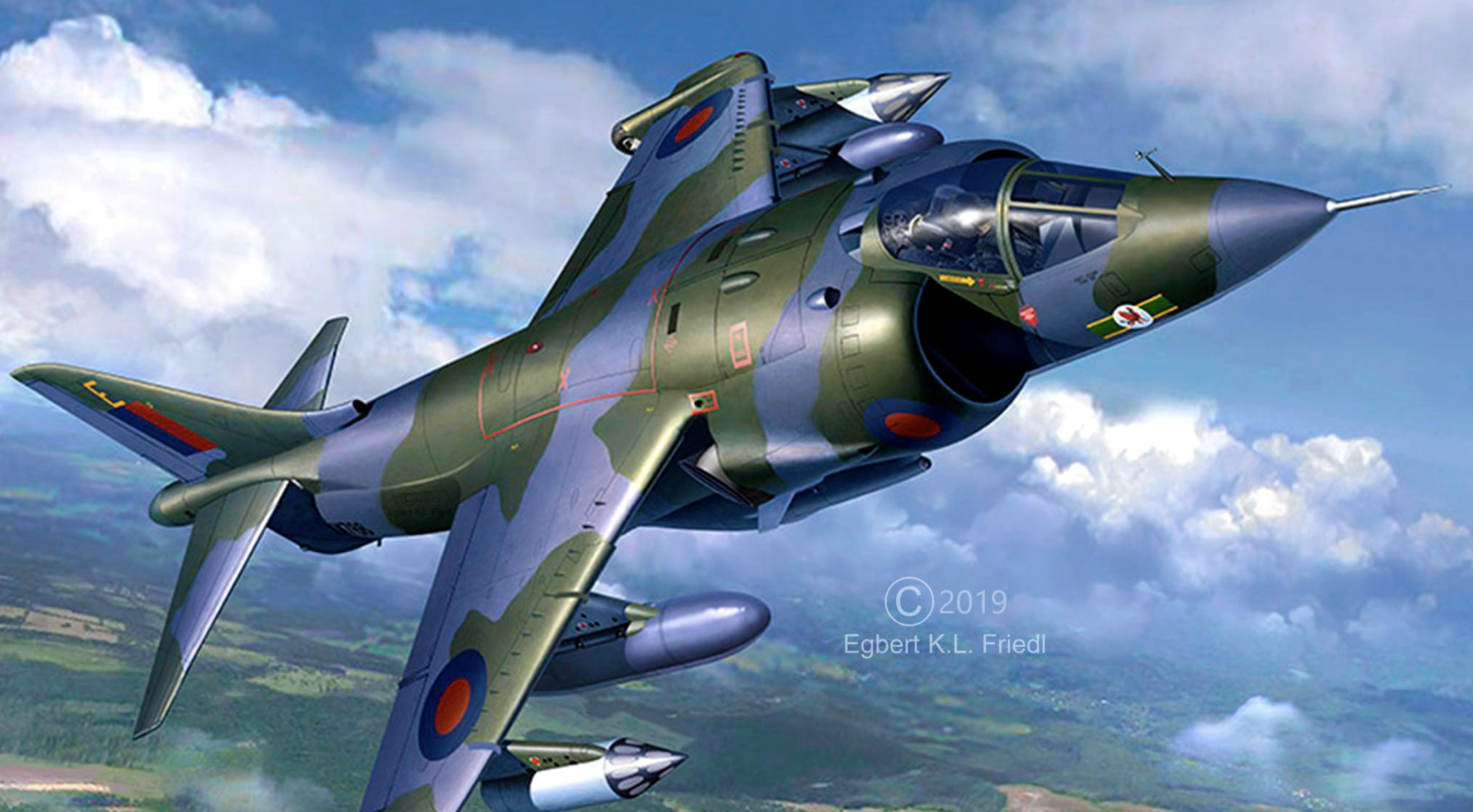
I guess this manifested itself most pleasingly last year, when I completed my Revell Harrier. Reissued so that the wider modelling public could buy this ancient kit (still, shamefully, the only way to build a 1st Generation Harrier in 1/32…) I knew that the kit would be popular and most likely finished in the kit’s colours and markings. Though I was teased by the idea of that, my subconscious mind wouldn’t allow me to complete the kit that way (at least not initially, I’m planning a GR3 in due course) so I scuttled off to find something that would set it apart. Having considered a Kestrel, I settled on the first of the Development Batch Harriers and the rest as they say, is history! If you would like to read more about this project, please check out the December 2022 edition of Model Airplane International, digital downloads of which can be found by clicking the following Pocketmags link:
https://pocketmags.com/model-airplane-international-magazine/209

Of course there is one final consideration for me at least and that’s my belligerent belief that older kits still have merit and that they offer challenges that others do not. At the risk of upsetting pretty much everyone, I don’t really feel that newer kits stretch me when it comes to construction, with only painting being a consideration (of course there are exceptions, but in the main, I consider that to be true). I like building models, with painting and decalling a secondary consideration. I also like to convert from scratch what’s in front on me. From my very earliest days in the hobby when I tried to convert a Matchbox Percival Provost into a CAC Winjeel using a guide published in an old issue of Airfix magazine, I’ve been interested in that part of the hobby. Today, with virtually everything imaginable available as a kit, I have to dig deep to still be able to tackle projects that offer that level of satisfaction. To me, building kits is great, but taking something forgotten and then showing what is still possible from it, is far more fulfilling and almost always, I like the resulting model more.
See you next time.
ARE YOU A FAN OF THE F-14 TOMCAT..?

..Then you will be interested to know that I have reprinted my modelling diode to building and painting Tamiya’s family of 1/48 kits. If you would like to know more about my book and its reprint, please check out the following link:
 SPENCER POLLARD'S KIT BOX
Some times old kits are the only game in town. I wanted to build a 1/72 Dornier Do28 and the only kit available was the Matchbox one from the mid 70s (reboxed by Revell at some point).
Also I built a Matchbox Messerschmitt 110 for The Interesting Modelling Company group build ‘Matchbox May’ last year and enjoyed it immensely. It’s not the most accurate kit available of the Bf110 but it was fun to see what I could do with an ancient model so I see where you are coming from 🙂
LikeLike
Nice piece of pros!
Whilst enjoying the latest releases, I find as much excitement, if not more, in Airfix’s vintage releases.
I am now the proud owner of 6 Beagle Basset’s and the relevant Xtradecal sheet and am being seriously tempted by the Beaver. Why? Because they are both still niche and require modelling skills.
Guess I’ve reached that age…
LikeLike
Absolutely agree Spence. Totally aligns with my thinking too. I love to watch experts pouring over the latest wonder kit, critiquing the designers riveting (counter sunk or domed…?) and panel lines (over lapped surely?) even following build reviews on Youtube in 20+ episodes but I can’t summon up too much excitement. I dare not even start it if it takes these guys that much effort…
No. I too love those classics on the basis that they can only be improved in my hands. Nostalgia for a childhood spent sticking together Airfix Zero’s and Boomerangs with gluely fingerprints perhaps… But I get more excitement from tracking down an old Airfix Canberra B(I)6 and sorting its shape issues ( helped by fellow modellers turning out new 3D parts) adding wheel wells, reshaping engines, thinning wing trailing edges or even producong an unavailable mark – PR7 anyone…?. I might even venture into homemade decals to depict the bird of my choice.
LikeLike
I enjoy your slightly unusual builds.
LikeLike
Agree with all the above comments as well as yours Spencer… in addition, some of the older kits will at least generate a model in half the time of an Uber kit as a result of less complexity. I, m a painter and decorator type of modeller not really enjoying the assembly phase so moving onto paint and weathering is more my thing… each to his own I guess..
Kudos to the big brands for bringing us such incredible kits these days but I, m more and more turning to the older less complex kits so I can get into the painting stage earlier
LikeLike
I wholeheartedly agree. Of course, as the Classic British Kits SIG lead, I would.
LikeLike
i have collected some old model kits ,,,williams vintage racers…looking for a good home,/ builder that would appreciate…any suggestions
LikeLike
I can understand the need to be different, and the sense of acomplishment of raising the bar on an old kit can provide, but the examples shown above are largely for jets, and I feel this changes everything. New WWII kits, since Eastern Europe raised the bar in 2008-2013, are simply completely different animals compared to virtually all previous WWII era kits ever made. Unlike jets, there is no longer any comparison with what existed before and the 2008 Zvezda LA-5FN, the 2010 Zvezda Me-109F, and finally the 2013 Eduard Spitfire Mark IX. These 3 kits, particularly the last one, completely changed the scale.
The biggest difference between these 3 kits and virtually ALL previous WWII kits boils down to one simple thing: Wingtips! Almost no previous 1/48 WWII kit had correct wing tip airfoils and thicknesses, not even slightly, except maybe two that were thick on the original: Tamiya’s 1998 F4U, and Hasegawa’s 1999 Typhoon. The Tamiya 2003 P-47 and newtool 2008 A6M5 were there, but with inaccurate fuselages… In 1/32 scale there were many kits with correct wing tips from 1999 onward, but 1/32 is, in my opinion, an non versatile scale for reasons too numerous to list.
Why do wing tips matter so much? Because without correct wing tips there is no correct airfoil, and the airfoil is considered the HEART of the aircraft… So previous WWII 1/48th scale aircrafts were nearly all wrong in the very heart of the subject, which to my eyes made them look exactly like what they were: Approximations.
LikeLike